Betta Under The Radar

A broken on-line papier machine
Saturday, February 10, 2007
I love this artist
I exhibited with Lynn Lu in Open Sea at The Substation, Singapore last year. She's a performance artist after my own heart - completely inspiring, elegant, assured work. She's responsible for chopping my hair off too, something I'm infinitely grateful for, as this hairstyle was perfect for me looking for a new direction. Check out her work on her website: www.lynnlu.info
I predict the day when everyone knows her name is not far off.
¶ 1:21 PM 0 comments
I predict the day when everyone knows her name is not far off.
¶ 1:21 PM 0 comments
Saturday, January 13, 2007
Francis Alys
I seriously love this artist - and I'm glad because loving a new artist means a new direction. Former influences include Simryn Gill, Wong Hoy Cheong and Elizabeth Presa. I'm restless with all this text stuff. Especially after checking out Simryn Gill's latest Pearls series. Very beautiful and intricate. But - it is not enough for me anymore. It's too hermetic and I am feeling desperate. I want dirt and grime, something off the streets, which is what Francis Alys talks about:
"No ivory tower allowed for the street will always beat your imagination... So, might as well stay on the street... "
Nice.
"No ivory tower allowed for the street will always beat your imagination... So, might as well stay on the street... "
Nice.
Labels: art
¶ 10:05 PM 0 comments
Friday, January 12, 2007
Oh Yoko

Yoko Ono in an interview with Everett True for Plan B magazine:
“It’s almost like the trees in the park. Some people think you should cut all the trees in Central Park because you can make tons of money. That’s denying the trees. If you cut all the trees in Central Park, you would notice that this city is no longer the city it was, so you would see that the trees are important. I’m like one of those trees. I’m just being myself and staying alive.”
Do you find yourself getting angrier as you get older?
“Listen, I’m not mellowing at all. What is there to mellow for? The kind of world we’re living in, how could we be mellow? The artist’s world is becoming more important and more urgent. Art is a way of survival. I said this in my liner notes, there’s a guy in St Petersburg, a DJ who put a metronome on because the whole city was in a siege and there was no food, nothing, and people were getting lethargic. The DJ was playing all kinds of music and making people happy. But then he became lethargic too and he put the metronome on and the whole city was just listening to it, tick tock, tick tock. That’s how they survived. That is the thing that was needed, not tap-dancing but a metronome. Artists are going to be the metronome of this society.”
Clicky for full transcript

Yoko Ono in an interview with Everett True for Plan B magazine:
“It’s almost like the trees in the park. Some people think you should cut all the trees in Central Park because you can make tons of money. That’s denying the trees. If you cut all the trees in Central Park, you would notice that this city is no longer the city it was, so you would see that the trees are important. I’m like one of those trees. I’m just being myself and staying alive.”
Do you find yourself getting angrier as you get older?
“Listen, I’m not mellowing at all. What is there to mellow for? The kind of world we’re living in, how could we be mellow? The artist’s world is becoming more important and more urgent. Art is a way of survival. I said this in my liner notes, there’s a guy in St Petersburg, a DJ who put a metronome on because the whole city was in a siege and there was no food, nothing, and people were getting lethargic. The DJ was playing all kinds of music and making people happy. But then he became lethargic too and he put the metronome on and the whole city was just listening to it, tick tock, tick tock. That’s how they survived. That is the thing that was needed, not tap-dancing but a metronome. Artists are going to be the metronome of this society.”
Clicky for full transcript
Labels: art
¶ 3:58 PM 0 comments
Monday, November 27, 2006
Plug: Kim Ng's Fact or Fiction @ Wei-Ling Gallery
I was asked to write an essay for Kim Ng's show at Wei-Ling Gallery. It opens December 4 oops it's December 15 (8pm), with Christmas Carols and (it is hoped) tee many martoonis. Here's the essay, steamin' fresh off the key-pads along with a coupla images.
Writing is getting harder and harder - only the prospect of a measely writer's fee was able to motivate me enough to get it done. Not that the work sucks, mind you. I always love a printmaker, especially in Malaysia. Just that it's so hard to feel for anything lately - gotta dig really deep. I had to go deep deep for those memories: 'the laughter of a friend, the way sunlight, etc'. Whiskey helped. Ye-eess, I'm drinking at 2 in the afternoon. Go screw y'selves. Got it done, din' I? *Burp*
Kim Ng
Fact or Fiction
4 - 28 Dec 2006
Wei-Ling Gallery, Kuala Lumpur
Kim Ng: Impressions
There’s something intriguing about how bookstores arrange their shelves: fiction and non-fiction. It implies two separate worlds operating along different sets of rules and values – one rational, objective and factual in nature, the other based on make-belief, fantasy and escape. Combined, they make up a catalogue of the infinite ways we understand and experience our world.
This second solo exhibition of Kim Ng’s works brings to mind such a catalogue. On the one hand, it is a catalogue of what we may loosely call ‘facts’ (I prefer ‘non-fictions’) – photographic images of his surroundings, the landscape and his young son; as well as found objects like plants and plastic bags. But other than this, it is also a catalogue of visual treatments, a cornucopia of techniques including collage, woodcut, monoprinting, painting, drawing, silkscreen, photography, ceramics, embossing and etching. Together, a visual vocabulary emerges that is neither fact nor fiction, but something that tries to walk the line between.

Many of the works recall a pop-art aesthetic, particularly ones which feature silk-screened repetitions of images, such as Police.Polis, Scene (Nature and Urban) and Plot IV. But whereas pop-art deals with images as surface signs and commodities, Kim treats his images with a lot more tactility, often juxtaposing them with a print taken directly from a found object such as a plastic bag. The plastic bag, once a tactile thing full of volume, texture and even sound, becomes flattened onto the picture surface. This seems to suggest that images and impressions are more than flickers on the surface of the eye – that they can have odor, shape and depth.
Printmaking is essentially about taking an impression of something and transferring it onto another surface. It is a practice with a long tradition. The lithographic stone, copperplate and woodblock have a history in ink of several centuries. Silk-screening is modern in comparison – probably about 30 to 40 years old. Even the potato block projects you did as a child, or rubber stamps used by government servants to date their documents, these are all in the language of printmaking.

It is interesting that Kim is often associated as a printmaker, although his works clearly demonstrate a vibrant and fluid traveling between many mediums. One is seldom privileged over the other. This then could be because he engages with the language of printmaking, which is that of taking impressions. His Filling The Void series is a case in point. These intimate, delicate works are made by tracing the holes left in dead leaves by insects, then filling the shapes in with pencil and bitumen. The impression he has taken is not so much of the leaf object, but of the action of caterpillars’ jaws slowly munching through foliage. Likewise, the image that results is not a record, but a trace – very much like traces left on the mind by memories.
In the end, memories (like dreams) are a strange cocktail of fact and fiction. What we felt to be so real – like the laughter of a friend, or the way the light fell on a particularly sunny morning, or the smell of blood and sweat during a political rally – might exist only imperfectly and incompletely in our minds. Imagine, that in all the world, these memories are recorded in only one person – you. Does that make them less precious, less potent?
The wonderful thing about Kim’s works is that they are more than representations of his memories. They also talk about the way memory works. The range of his craft and diversity of visual vocabulary indicate that for every fact, there is an accompanying fiction; impressions are not solid or fixed, but fluid agents that need to be engaged with a constantly changing set of interfaces.
Sharon Chin
Kuala Lumpur, 2006
Writing is getting harder and harder - only the prospect of a measely writer's fee was able to motivate me enough to get it done. Not that the work sucks, mind you. I always love a printmaker, especially in Malaysia. Just that it's so hard to feel for anything lately - gotta dig really deep. I had to go deep deep for those memories: 'the laughter of a friend, the way sunlight, etc'. Whiskey helped. Ye-eess, I'm drinking at 2 in the afternoon. Go screw y'selves. Got it done, din' I? *Burp*
Kim Ng
Fact or Fiction
4 - 28 Dec 2006
Wei-Ling Gallery, Kuala Lumpur
Kim Ng: Impressions
There’s something intriguing about how bookstores arrange their shelves: fiction and non-fiction. It implies two separate worlds operating along different sets of rules and values – one rational, objective and factual in nature, the other based on make-belief, fantasy and escape. Combined, they make up a catalogue of the infinite ways we understand and experience our world.
This second solo exhibition of Kim Ng’s works brings to mind such a catalogue. On the one hand, it is a catalogue of what we may loosely call ‘facts’ (I prefer ‘non-fictions’) – photographic images of his surroundings, the landscape and his young son; as well as found objects like plants and plastic bags. But other than this, it is also a catalogue of visual treatments, a cornucopia of techniques including collage, woodcut, monoprinting, painting, drawing, silkscreen, photography, ceramics, embossing and etching. Together, a visual vocabulary emerges that is neither fact nor fiction, but something that tries to walk the line between.

Many of the works recall a pop-art aesthetic, particularly ones which feature silk-screened repetitions of images, such as Police.Polis, Scene (Nature and Urban) and Plot IV. But whereas pop-art deals with images as surface signs and commodities, Kim treats his images with a lot more tactility, often juxtaposing them with a print taken directly from a found object such as a plastic bag. The plastic bag, once a tactile thing full of volume, texture and even sound, becomes flattened onto the picture surface. This seems to suggest that images and impressions are more than flickers on the surface of the eye – that they can have odor, shape and depth.
Printmaking is essentially about taking an impression of something and transferring it onto another surface. It is a practice with a long tradition. The lithographic stone, copperplate and woodblock have a history in ink of several centuries. Silk-screening is modern in comparison – probably about 30 to 40 years old. Even the potato block projects you did as a child, or rubber stamps used by government servants to date their documents, these are all in the language of printmaking.

It is interesting that Kim is often associated as a printmaker, although his works clearly demonstrate a vibrant and fluid traveling between many mediums. One is seldom privileged over the other. This then could be because he engages with the language of printmaking, which is that of taking impressions. His Filling The Void series is a case in point. These intimate, delicate works are made by tracing the holes left in dead leaves by insects, then filling the shapes in with pencil and bitumen. The impression he has taken is not so much of the leaf object, but of the action of caterpillars’ jaws slowly munching through foliage. Likewise, the image that results is not a record, but a trace – very much like traces left on the mind by memories.
In the end, memories (like dreams) are a strange cocktail of fact and fiction. What we felt to be so real – like the laughter of a friend, or the way the light fell on a particularly sunny morning, or the smell of blood and sweat during a political rally – might exist only imperfectly and incompletely in our minds. Imagine, that in all the world, these memories are recorded in only one person – you. Does that make them less precious, less potent?
The wonderful thing about Kim’s works is that they are more than representations of his memories. They also talk about the way memory works. The range of his craft and diversity of visual vocabulary indicate that for every fact, there is an accompanying fiction; impressions are not solid or fixed, but fluid agents that need to be engaged with a constantly changing set of interfaces.
Sharon Chin
Kuala Lumpur, 2006
Labels: art
¶ 7:30 PM 0 comments
Sunday, August 20, 2006
Homeophatic Ways To Relieve Dreaded Artist Block
1. Clear out your studio, be ruthless with all failed experiments/sketches. THROW IT AWAY.
2. Press the FUCK IT button and go watch a movie
3. Consume other media - books, films, cartoons, autumn sunsets, etc.
4. Drink heavily in a bar where you don't know anyone. Talk to strangers.
5. Cook yourself food. This simple act of self-preservation/nurturing will put everything in context.
6. Make someone a present. Remember how good it feels to make things for the sake of making things?
7. Do the complete oppposite of what you are doing in the studio at the moment. If you are hanging shit, put it on the floor. If you are casting like there is no tomorrow, pick up a needle and thread. Etc.
8. Have good sex (this can be quite hard to arrange, the lack of which is sometimes the very reason for said Artist Block)
9. Drive to the airport
10. Buy stationary
11. Knock back a few shots of scotch and wander aimlessly around the local hardware store
Good luck.
xoxo,
betta.
2. Press the FUCK IT button and go watch a movie
3. Consume other media - books, films, cartoons, autumn sunsets, etc.
4. Drink heavily in a bar where you don't know anyone. Talk to strangers.
5. Cook yourself food. This simple act of self-preservation/nurturing will put everything in context.
6. Make someone a present. Remember how good it feels to make things for the sake of making things?
7. Do the complete oppposite of what you are doing in the studio at the moment. If you are hanging shit, put it on the floor. If you are casting like there is no tomorrow, pick up a needle and thread. Etc.
8. Have good sex (this can be quite hard to arrange, the lack of which is sometimes the very reason for said Artist Block)
9. Drive to the airport
10. Buy stationary
11. Knock back a few shots of scotch and wander aimlessly around the local hardware store
Good luck.
xoxo,
betta.
Labels: art
¶ 12:13 PM 0 comments
My Studio Practices
1. Imagination is more important than knowledge
But the more knowledge you have the more imaginative you are able to be.
2. Work makes more work
Work is a generative process centered around action. Action produces things. Waiting around hoping for that perfect genius idea to fall in your lap like the blessings of angels is generally a waste of time. With a tight deadline creeping up on you, you can apply the shortcut of brainstorming ideas, sometimes with great success. I've found I can do this better now with some experience under my belt. But as a process I find it utterly miserable - you feel like a production line, vomiting ideas on demand. Ideas are nothing without action. The process of making something will ultimately impose its own rules on the outcome of that thing.
3. Be the Fool
Avoid dependance on old strategies. Create problems for yourself and others. Do not have attachments to labels or expectations - these are only old tricks of a mind that resists change. Change is vitality. Vitality creates an art that lives.
4. 'Out of clutter, find simplicity. From discord, find harmony. In the middle of difficulty, lies opportunity.' - Albert Einstein's Rules of Work
5. Never hesitate to chuck shit out the window and start all over
Learn to let go, let go, let go. There WILL be other ideas.
But the more knowledge you have the more imaginative you are able to be.
2. Work makes more work
Work is a generative process centered around action. Action produces things. Waiting around hoping for that perfect genius idea to fall in your lap like the blessings of angels is generally a waste of time. With a tight deadline creeping up on you, you can apply the shortcut of brainstorming ideas, sometimes with great success. I've found I can do this better now with some experience under my belt. But as a process I find it utterly miserable - you feel like a production line, vomiting ideas on demand. Ideas are nothing without action. The process of making something will ultimately impose its own rules on the outcome of that thing.
3. Be the Fool
Avoid dependance on old strategies. Create problems for yourself and others. Do not have attachments to labels or expectations - these are only old tricks of a mind that resists change. Change is vitality. Vitality creates an art that lives.
4. 'Out of clutter, find simplicity. From discord, find harmony. In the middle of difficulty, lies opportunity.' - Albert Einstein's Rules of Work
5. Never hesitate to chuck shit out the window and start all over
Learn to let go, let go, let go. There WILL be other ideas.
Labels: art
¶ 11:43 AM 0 comments
Friday, July 14, 2006
Art Notation
Exhausted.
The equivalent of roadkill - body squashed but head still juicy.
Football field and bubbles... floating bubbles. That's an installation, room-sized. Astroturf the whole gallery, lit only by a green neon border. Floating bubbles from some unknown source. Surrounded by photographs of players, but the football is photoshopped out, replaced with a bubble...
Ok this idea I'm very happy with. Ia datang pagi ni seperti manna dari syurga, heheh. Sebuah alat permainan 'Newton's Cradle', tapi berganda besar and bola besinya diganti oleh bola sepak. Kalau dapat funding, keseluruhannya dibuat daripada stainless steel. Mungkin untuk RD WWF show bulan Sept akan datang - sempatkah? Hmm.
The equivalent of roadkill - body squashed but head still juicy.
Football field and bubbles... floating bubbles. That's an installation, room-sized. Astroturf the whole gallery, lit only by a green neon border. Floating bubbles from some unknown source. Surrounded by photographs of players, but the football is photoshopped out, replaced with a bubble...
Ok this idea I'm very happy with. Ia datang pagi ni seperti manna dari syurga, heheh. Sebuah alat permainan 'Newton's Cradle', tapi berganda besar and bola besinya diganti oleh bola sepak. Kalau dapat funding, keseluruhannya dibuat daripada stainless steel. Mungkin untuk RD WWF show bulan Sept akan datang - sempatkah? Hmm.
Labels: art
¶ 4:47 PM 0 comments
Wednesday, May 17, 2006
Thoughts on Installation Art in terms of :
STATISTICS
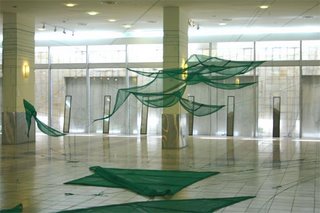
300 square metres scaffold netting. 2000 metres green nylon rope. 75 stainless steel grommets. 10 ladders. Approx. 150 cable clips. Installed over 48 hours. Approx. total construction and preparation time of 3 months (not including conception).
HUMAN RESOURCE
23 assistants and helpers
DE-INSTALLATION OF WORK
2 pairs of scissors and 10 minutes
*Go here to see it when up

EPHEMERALITY
The process of taking it down is as deeply satisfying as putting it up. The wreckage has a reckless and poignant quality, with an edge of hysterical laughter creeping in the edges: this, the source of so much sweat and worry - in the end, nothing. Documentation in a faded way in images. Only the vague experience of it, held in memory by people who have seen it, who had a hand it making it, touched it at certain edges and angles. For myself, no sense at all of preciousness, in fact, I am light. As happy in the destruction as construction (and in a sick way, maybe even happier), because this is the natural course of things. The same afternoon, the space was used for a cocktail reception.
LABOUR
For what? Outside E.H.'s attic where I sewed most of the sails, I could see a house being built. Construction workers grow dark in the midday sun - mixing concrete, laying concrete, drilling, welding, bending, pouring, lifting, knocking, smoking, eating, drinking. I do the same thing concurrently - sewing, pinning, folding, cutting, smoking, eating, drinking. In the end we are trying to build a thing that we can see. But the thing has a different use. A house has a fixed value, and a house may be used to live in. You cannot live in an installation. What do we use it for then? Is the difference in the product as a result of the difference in our labour? Hence value? Hence access? How am I different from a construction worker?
FAVORITE REACTION
A dark little Indonesian man works at the High Commission in building maintence. He spent two years on the coast of Melaka, building buildings. He described himself as Orang Laut, i.e. 'Saya orang laut, mesti taulah' ('I am a person of the sea, of course I can tell'). For him, the shores are the mountains (or rather gunung berapi/volcano), the sails are the fishing nets, the concrete is the sea. I am questioned, as a KL person, how and why I should talk about ships and the ocean, since there is no such thing in the city. I replied that this is a city ocean, and I'm lost. He called me 'lang lui' (pretty), which is always nice.
AUDIENCE
Still have immense trouble describing what I do when people here (KL) ask 'what do you do'. 'Sculpture', I find, satisfies both myself and them. I flirt with 'set design, but not really, but something like it', but I think... ok, no. Installation is sculpture because sculpture is material, space. Installation is an exploded sculpture. Installation is an exploded planet, in which one planet has exploded to create many planets, which as a whole, is another universe.
BEUYS
If I make objects, I think of Marcel Duchamp, if I make installations, I think of Joseph Beuys. Thought as a form of sculpture, sculpture as a form of action.
"My objects are to be seen as stimulants for the transformation of the idea of sculpture. . . or of art in general. They should provoke thoughts about what sculpture can be and how the concept of sculpting can be extended to the invisible materials used by everyone.
THINKING FORMS--how we mold our thoughts or
SPOKEN FORMS--how we shape our thoughts into words or
SOCIAL SCULPTURE--how we mold and shape the world in which we live:
SCULPTURE AS AN EVOLUTIONARY PROCESS; EVERYONE IS AN ARTIST.
That is why the nature of my sculpture is not fixed and finished, processes continue in most of them: chemical reactions, fermentations, color changes, decay, drying up. Everything is in a state of change."
-from Carin Kuoni, ed., Energy Plan for the Western Man: Joseph Beuys in America (New York: Four Walls Eight Windows, 1990), 19.
MONTIEN BOONMA
I wish I could have met him.
MALAYSIAN ART (More thought and examples needed here, but am running out of steam)
'Installation' is becoming ubiquitous, but for all the wrong reasons. There is a proliferation of the form, but not an increase in quality of conception or execution. We use installation, yet we do not think about it. It has become too convenient, objects hung in space. Conversely there is a sort of backlash, in which it is referred to in a derogatory manner as 'installation bullshit' (source : personal conversation with Dr. Jolly Koh, Malaysian abstract expressionist painter).
300 square metres scaffold netting. 2000 metres green nylon rope. 75 stainless steel grommets. 10 ladders. Approx. 150 cable clips. Installed over 48 hours. Approx. total construction and preparation time of 3 months (not including conception).
HUMAN RESOURCE
23 assistants and helpers
DE-INSTALLATION OF WORK
2 pairs of scissors and 10 minutes
*Go here to see it when up


EPHEMERALITY
The process of taking it down is as deeply satisfying as putting it up. The wreckage has a reckless and poignant quality, with an edge of hysterical laughter creeping in the edges: this, the source of so much sweat and worry - in the end, nothing. Documentation in a faded way in images. Only the vague experience of it, held in memory by people who have seen it, who had a hand it making it, touched it at certain edges and angles. For myself, no sense at all of preciousness, in fact, I am light. As happy in the destruction as construction (and in a sick way, maybe even happier), because this is the natural course of things. The same afternoon, the space was used for a cocktail reception.
LABOUR
For what? Outside E.H.'s attic where I sewed most of the sails, I could see a house being built. Construction workers grow dark in the midday sun - mixing concrete, laying concrete, drilling, welding, bending, pouring, lifting, knocking, smoking, eating, drinking. I do the same thing concurrently - sewing, pinning, folding, cutting, smoking, eating, drinking. In the end we are trying to build a thing that we can see. But the thing has a different use. A house has a fixed value, and a house may be used to live in. You cannot live in an installation. What do we use it for then? Is the difference in the product as a result of the difference in our labour? Hence value? Hence access? How am I different from a construction worker?
FAVORITE REACTION
A dark little Indonesian man works at the High Commission in building maintence. He spent two years on the coast of Melaka, building buildings. He described himself as Orang Laut, i.e. 'Saya orang laut, mesti taulah' ('I am a person of the sea, of course I can tell'). For him, the shores are the mountains (or rather gunung berapi/volcano), the sails are the fishing nets, the concrete is the sea. I am questioned, as a KL person, how and why I should talk about ships and the ocean, since there is no such thing in the city. I replied that this is a city ocean, and I'm lost. He called me 'lang lui' (pretty), which is always nice.
AUDIENCE
Still have immense trouble describing what I do when people here (KL) ask 'what do you do'. 'Sculpture', I find, satisfies both myself and them. I flirt with 'set design, but not really, but something like it', but I think... ok, no. Installation is sculpture because sculpture is material, space. Installation is an exploded sculpture. Installation is an exploded planet, in which one planet has exploded to create many planets, which as a whole, is another universe.
BEUYS
If I make objects, I think of Marcel Duchamp, if I make installations, I think of Joseph Beuys. Thought as a form of sculpture, sculpture as a form of action.
"My objects are to be seen as stimulants for the transformation of the idea of sculpture. . . or of art in general. They should provoke thoughts about what sculpture can be and how the concept of sculpting can be extended to the invisible materials used by everyone.
THINKING FORMS--how we mold our thoughts or
SPOKEN FORMS--how we shape our thoughts into words or
SOCIAL SCULPTURE--how we mold and shape the world in which we live:
SCULPTURE AS AN EVOLUTIONARY PROCESS; EVERYONE IS AN ARTIST.
That is why the nature of my sculpture is not fixed and finished, processes continue in most of them: chemical reactions, fermentations, color changes, decay, drying up. Everything is in a state of change."
-from Carin Kuoni, ed., Energy Plan for the Western Man: Joseph Beuys in America (New York: Four Walls Eight Windows, 1990), 19.
MONTIEN BOONMA
I wish I could have met him.
MALAYSIAN ART (More thought and examples needed here, but am running out of steam)
'Installation' is becoming ubiquitous, but for all the wrong reasons. There is a proliferation of the form, but not an increase in quality of conception or execution. We use installation, yet we do not think about it. It has become too convenient, objects hung in space. Conversely there is a sort of backlash, in which it is referred to in a derogatory manner as 'installation bullshit' (source : personal conversation with Dr. Jolly Koh, Malaysian abstract expressionist painter).
Labels: art
¶ 4:34 PM 1 comments
Wednesday, May 10, 2006
Last call for Fourth World
This show is shorter than usual and comes down this Monday, 15 May. Go see while you can! It is closed this Friday for Wesak Day and not open over the weekend. That leaves... hmmm, tomorrow and Monday morning. Opening hours 8.30am - 4.30pm.
Ah well, if you missed it, I finally uploaded new images to the blog site. http://4ourthworld.blogspot.com. Go on, click. You know you want to.
xoxo,
Betta Schemetta
Ah well, if you missed it, I finally uploaded new images to the blog site. http://4ourthworld.blogspot.com. Go on, click. You know you want to.
xoxo,
Betta Schemetta
Labels: art
¶ 5:10 PM 2 comments
Friday, April 28, 2006
Post Tempest
The most beautiful clear day, a milky blue sky, as if everything has been washed twice and has come out gleaming, beaming. And the night before was only a dream of a Tempest - a dream in which one was spirited away to a fairie court, where one drank champagne and spoke in loud earnest tones and was carassed by emminent figures who said such pretty things. There was a perfect green dress and a pair of lovely, if not very comfortable, silver-white shoes. It was just as well there was no dancing. Did you know, there is a person or god or amorphous being who controls time with a pocket watch? When it pleases him, he winds it so that the hours pass by in a blurred flash. And the Tempest never really lasts, and you wake up... strangely empty, quite stupid and slow. If asked, one would say that a wonderful time was had, when in fact, one doubts that it was real at all.
Labels: art
¶ 2:11 PM 0 comments
Thursday, April 13, 2006
Fourth World
http://4ourthworld.blogspot.com
All are most cordially invited! I am still working night and day, producing work like a machine - a very ill-tempered machine - but we will keep that between you and me. Let popular opinion be that I am totally organized and as calm as a monk.
All are most cordially invited! I am still working night and day, producing work like a machine - a very ill-tempered machine - but we will keep that between you and me. Let popular opinion be that I am totally organized and as calm as a monk.
Labels: art
¶ 3:36 PM 0 comments
Thursday, March 23, 2006
HOW TO BE A VISUAL ART CRITIC IN MALAYSIA
A SERIALIZED GUIDE TO SKILLS YOU WILL NEED:
THIS WEEK'S SKILL : DESCRIPTION
To be able to describe a work of art in ten sentences or more is an essential skill for all prospective critics in this country. The ability to wax lyrical about the color blue, for example, or the 'sublime composition of visual elements within the rigid confines of the frame' will allow you to conveniently fill up oh-so-much column space, WITHOUT THE ACTUAL NEED TO THINK. You will still sound eloquent, as if you know what you are talking about, which of course, you don't. Amazingly, with a great deal of practice, you can even apply the Descriptive Tool to conceptual art, AND NOT SOUND STUPID. We suggest you take Duchamp's Urinal upon which to practice your descriptive faculties. Be sure to mention how lightly the urinal appears to sit there, exuding the aura of an everyday object, asserting its own right to existence, and how the artist asserts his right to bring it into existence. If you are having trouble with this skill, please keep this tip in mind: remember that the ordinary Malaysian mortal (i.e not yourself) cannot possibly see that an artwork is green, or red, or big, or small, or gestural, or... even, conceptual. When you are aware of the sheer visual dumbass-ness of your readers, you will realize that you must describe, describe, describe. It is your duty.
NEXT SOON (OR NEVER) : NON-OFFENSIVENESS
How to not have an opinion on anything but still be considered an important source of art criticism.
THIS WEEK'S SKILL : DESCRIPTION
To be able to describe a work of art in ten sentences or more is an essential skill for all prospective critics in this country. The ability to wax lyrical about the color blue, for example, or the 'sublime composition of visual elements within the rigid confines of the frame' will allow you to conveniently fill up oh-so-much column space, WITHOUT THE ACTUAL NEED TO THINK. You will still sound eloquent, as if you know what you are talking about, which of course, you don't. Amazingly, with a great deal of practice, you can even apply the Descriptive Tool to conceptual art, AND NOT SOUND STUPID. We suggest you take Duchamp's Urinal upon which to practice your descriptive faculties. Be sure to mention how lightly the urinal appears to sit there, exuding the aura of an everyday object, asserting its own right to existence, and how the artist asserts his right to bring it into existence. If you are having trouble with this skill, please keep this tip in mind: remember that the ordinary Malaysian mortal (i.e not yourself) cannot possibly see that an artwork is green, or red, or big, or small, or gestural, or... even, conceptual. When you are aware of the sheer visual dumbass-ness of your readers, you will realize that you must describe, describe, describe. It is your duty.
NEXT SOON (OR NEVER) : NON-OFFENSIVENESS
How to not have an opinion on anything but still be considered an important source of art criticism.
Labels: art, art writing
¶ 10:33 AM 4 comments
Thursday, March 16, 2006
Applicability vs. Allegory
This is just a quick note to ensure that I don't forget - an idea that I think is obscurely important to me and will be to this show. Incredibly this came out of the Foreword by Tolkien to the 2nd Edition of Lord of the Rings.
Basically he was saying that he far preferred Applicability to Allegory, and that the two often get confused. History, whether truth or invention, could be used or applied practically by the reader. Wheareas Allegory (to my mind - an allegory is a story masquerading as a comment or reflection on another issue altogether) dictates the reader, sets the rules and boundaries for imagination, so to speak.
I agree with him, and make my work coming from this perspective. I want my work to be a practical (re)invention of systems, not a symbolic narrative. The sails are not theatrical, they are practical. They serve a purpose in the particular space in which they are hung. Texts are also practical. They are as practical as ropes, and knots that you tie with ropes.
I was very happy to have come across that particular passage at this particular time. Looking at the artists that I like and admire (Joseph Beuys, Montien Boonma, Vong Phaophanit, Elizabeth Presa), I think I was geared towards this way of thinking from the year one. But Tolkien happened to articulate this visual bent succintly with the right words.
Strange that a passage written in the 1950s as a foreword to a Fantasy novel should have such applicability to what I am trying to do. Strange and infinitely cool.
Basically he was saying that he far preferred Applicability to Allegory, and that the two often get confused. History, whether truth or invention, could be used or applied practically by the reader. Wheareas Allegory (to my mind - an allegory is a story masquerading as a comment or reflection on another issue altogether) dictates the reader, sets the rules and boundaries for imagination, so to speak.
I agree with him, and make my work coming from this perspective. I want my work to be a practical (re)invention of systems, not a symbolic narrative. The sails are not theatrical, they are practical. They serve a purpose in the particular space in which they are hung. Texts are also practical. They are as practical as ropes, and knots that you tie with ropes.
I was very happy to have come across that particular passage at this particular time. Looking at the artists that I like and admire (Joseph Beuys, Montien Boonma, Vong Phaophanit, Elizabeth Presa), I think I was geared towards this way of thinking from the year one. But Tolkien happened to articulate this visual bent succintly with the right words.
Strange that a passage written in the 1950s as a foreword to a Fantasy novel should have such applicability to what I am trying to do. Strange and infinitely cool.
Labels: art
¶ 1:41 PM 0 comments
Friday, February 17, 2006
URGENT : Knot Request
If anyone knows the right knot to attach a rope to a square (i.e non-cylindrical) post, please let me know, and you shall have my eternal gratitude.
The weight upon the rope will not be great, but the problem here is the slipping of the rope down the post (which is rectangular). It is for an installation I am making, involving suspension of large pieces of netting from angular pillars.
Any assistance/suggestions are greatly appreciated. Thanks T.W. for those links, especially the kite-building one. I've already visited most of the major knot-sites on the web, all of them only have knots that will work on a cylindrical post. (Clove hitches, Rolling hitches, etc).
The weight upon the rope will not be great, but the problem here is the slipping of the rope down the post (which is rectangular). It is for an installation I am making, involving suspension of large pieces of netting from angular pillars.
Any assistance/suggestions are greatly appreciated. Thanks T.W. for those links, especially the kite-building one. I've already visited most of the major knot-sites on the web, all of them only have knots that will work on a cylindrical post. (Clove hitches, Rolling hitches, etc).
Labels: art
¶ 7:13 PM 0 comments
Monday, February 13, 2006
Confine Thyself to Silent Prayer
Smile on me, oh God of Deadlines. I promise I will never procrastinate again. I will schedule and I will plan. I will buy a mini-organizer with funky page dividers and memo pages. With hologram cover and calendar. With currency conversion rate and world-time zones and world census statistics from 1980.
And I will sacrifice two juicy kittens who are currently over-running my house like little rats. I know they are not righfully mine, but the neighbor already has 30 of them and she will not miss two.
Oh man I am so key-ed up on coffee and cigarettes. Die all you fucking artists. Oh wait I am one of them. How'd you like to use a sewing machine, huh? HUH? HUH? Yes you could write your artist statement with it. That will impress them willy nilly. Oh yes, darling, I think you're the bee-knees too. THE BEES' KNEES, I tell you!
The bees' knees. *Weep*
And I will sacrifice two juicy kittens who are currently over-running my house like little rats. I know they are not righfully mine, but the neighbor already has 30 of them and she will not miss two.
Oh man I am so key-ed up on coffee and cigarettes. Die all you fucking artists. Oh wait I am one of them. How'd you like to use a sewing machine, huh? HUH? HUH? Yes you could write your artist statement with it. That will impress them willy nilly. Oh yes, darling, I think you're the bee-knees too. THE BEES' KNEES, I tell you!
The bees' knees. *Weep*
Labels: art
¶ 8:27 PM 0 comments
Friday, January 27, 2006
How To Be a Visual Artist in Malaysia
*Remember: If you're not an artist in Kuala Lumpur, you don't count. (If you're an artist in Perak, you count a little)
1. Go to art school. Have as much fun as you can. It's all downhill from there.
2. Learn not to believe people who are optimistic about your financial future. Yes, it is as bleak as you suspect.
3. Get used to the idea of working a shitty part-time job for 5 ringgit an hour to finance your passion. Yes, for the rest of your life. Or until you 'make it'. (Haha)
4. Have you always relied on your parents for food, clothing and occasional bail-outs? Well at least some things'll never change.
5. Smile as your successful friends buy a new car/get married/talk about clothes sales. Remember these are the people you can borrow money from.
6. Did you borrow money from friends? You can lessen the humiliation by joking hollowly about it being a future investment. They can feel a sense of fulfillment by having had a hand in your 'making it'.
7. Depression is your friend.
8. Alcohol is your friend.
9. It is not morally wrong to wish for a rich boy/girlfriend, leech off them for the duration of your ill-fated relationship and then deride them for not being 'deep' enough.
10. Please, for the sake of your sanity, rid yourself of the illusion that being an artist will get you laid. That only happens to architects. Sucks to be you. Wrong career choice.
11. Get to know mamak food really well. You will find yourself eating it on a regular basis. In time, you will be able to identify items on the menu of maximum nutritional value and minimum cost.
12. If you want to 'make it', you should do at least one artwork about race relations in Malaysia. Be sure to offend every religious and ethnic group with well-worn stereotypes and mask your deep ignorance of current affairs with a Baudrillardian sense of irony and futility.
13. Always avoid talking to Dr. Jolly Koh, unless you're bored. If you are an installation artist, prepare to be told you are worthless.
14. Posture arrogantly in a 'ram-you-damn-you-capitalist pigs' way in your art, but suck-up to collectors in real life.
15. Indulge in vehement, unfocused bitching about Valentine Willie Fine Art, but still sell your work there for RM 10,000.
16. If your work is censored or you are detained under ISA, you are god.
17. You will be asked 'what do you do' with annoying frequency. It is not morally wrong to lie and say 'I work for my father'. You could also say 'I'm an artist' and then laugh hysterically.
18. Dream about leaving this god-forsaken rock. It is the one thing that will keep you going. Once you are happily installed in another country, you can love it from a distance and make work about your cross-cultural experience.
19. White people still hold the key to your successful career as an artist.
20. Collaboration is the new Hirst. Jalaini Abu Hassan is the new Syed Ahmad Jamal. Wong Hoy Cheong is the new Wong Hoy Cheong. Kakiseni is the new Balai Seni Lukis. Commenting on Kakiseni is the new Free Speech. Off the Edge is the new Kakiseni. Iraq is the new America. The local police force is the new George Bush. Thank god for ISA as a constant source of 100 percent genuine angst.
21. Money is your enemy. You will fight it the rest of your life. Or until you 'make it'. (Haha) You're not addicted to drugs, you're just self-medicating. You want to have children? What the fuck is wrong with you?
NEXT SOON (OR NEVER): THE TYPES OF ARTISTS
1. Go to art school. Have as much fun as you can. It's all downhill from there.
2. Learn not to believe people who are optimistic about your financial future. Yes, it is as bleak as you suspect.
3. Get used to the idea of working a shitty part-time job for 5 ringgit an hour to finance your passion. Yes, for the rest of your life. Or until you 'make it'. (Haha)
4. Have you always relied on your parents for food, clothing and occasional bail-outs? Well at least some things'll never change.
5. Smile as your successful friends buy a new car/get married/talk about clothes sales. Remember these are the people you can borrow money from.
6. Did you borrow money from friends? You can lessen the humiliation by joking hollowly about it being a future investment. They can feel a sense of fulfillment by having had a hand in your 'making it'.
7. Depression is your friend.
8. Alcohol is your friend.
9. It is not morally wrong to wish for a rich boy/girlfriend, leech off them for the duration of your ill-fated relationship and then deride them for not being 'deep' enough.
10. Please, for the sake of your sanity, rid yourself of the illusion that being an artist will get you laid. That only happens to architects. Sucks to be you. Wrong career choice.
11. Get to know mamak food really well. You will find yourself eating it on a regular basis. In time, you will be able to identify items on the menu of maximum nutritional value and minimum cost.
12. If you want to 'make it', you should do at least one artwork about race relations in Malaysia. Be sure to offend every religious and ethnic group with well-worn stereotypes and mask your deep ignorance of current affairs with a Baudrillardian sense of irony and futility.
13. Always avoid talking to Dr. Jolly Koh, unless you're bored. If you are an installation artist, prepare to be told you are worthless.
14. Posture arrogantly in a 'ram-you-damn-you-capitalist pigs' way in your art, but suck-up to collectors in real life.
15. Indulge in vehement, unfocused bitching about Valentine Willie Fine Art, but still sell your work there for RM 10,000.
16. If your work is censored or you are detained under ISA, you are god.
17. You will be asked 'what do you do' with annoying frequency. It is not morally wrong to lie and say 'I work for my father'. You could also say 'I'm an artist' and then laugh hysterically.
18. Dream about leaving this god-forsaken rock. It is the one thing that will keep you going. Once you are happily installed in another country, you can love it from a distance and make work about your cross-cultural experience.
19. White people still hold the key to your successful career as an artist.
20. Collaboration is the new Hirst. Jalaini Abu Hassan is the new Syed Ahmad Jamal. Wong Hoy Cheong is the new Wong Hoy Cheong. Kakiseni is the new Balai Seni Lukis. Commenting on Kakiseni is the new Free Speech. Off the Edge is the new Kakiseni. Iraq is the new America. The local police force is the new George Bush. Thank god for ISA as a constant source of 100 percent genuine angst.
21. Money is your enemy. You will fight it the rest of your life. Or until you 'make it'. (Haha) You're not addicted to drugs, you're just self-medicating. You want to have children? What the fuck is wrong with you?
NEXT SOON (OR NEVER): THE TYPES OF ARTISTS
Labels: art
¶ 10:24 AM 5 comments
Monday, January 16, 2006
The Fourth World
And I looked upon the true sea - the sea that plays with men till their hearts are broken, and wears stout ships to death.
Joseph Conrad
When the Ice Age ended, the ocean levels rose and the lower ground became ocean floor again, submerging any record of the pioneers' coastal civilizations. The land bridges disappeared under higher seas, and the people who had ventured to Australia and Tasmania each evolved independently, cut off from contact with the rest of the world until modern times.
Thomas Suarez, Early Mapping of the Pacific (2004)
If a person asked my advice, before undertaking a long voyage, my answer would depend upon his possessing a decided taste for some branch of knowledge, which could by this means be advanced. No doubt it is a high satisfaction to behold various countries and the many races of mankind, but the pleasures gained at the time do not counterbalance the evils. It is necessary to look forward to a harvest, however distant that may be, when some fruit will be reaped, some good effected. Many of the losses which must be experienced are obvious; such as that of the society of every old friend, and of the sight of those places with which every dearest remembrance is so intimately connected. These losses, however, are at the time partly relieved by the exhaustless delight of anticipating the long wished-for day of return...
Charles Darwin, The Voyage of the Beagle (1839)
___________________________
Working Title
"Fourth World"
The Site
The Australian High Commission sits in the heart of Kuala Lumpur, on a street opposite the Twin Towers. My first memory of the place was when I applied for a visa to study in Melbourne. One is admitted through two glass sliding doors and then greeted by a wide concourse area. You go upstairs where your application will be processed and if all goes well (it usually does) a sticker is put in your passport. For this reason I have always thought of the High Commission as a sort of portal to another life in another place. The very beginning of a journey with an inconceivable outcome.
Now, about four years later, I am back living and working in Kuala Lumpur. The journey is over, and I am to create a piece of work in the very place I started from! It has not altered in appearance, but I am wholly changed. The ticket of that outward journey has led me back to where it was first issued to me.
Proposed Work
The work I propose for this exhibition is a large-scale installation taking up much of the right side (from the direction walking in the entrance) of the High Commission. It will consist of near full-size representations of a suite of sails from a square-rigged sailing ship. These sails are not to be made from the usual canvas, but from heavy green netting - the type that is used in scaffolding, that you may see shrouding any number of half-built high-rises around town. The sails are hung from the ceiling and weighted down by clear little bags filled with raw concrete. They face the floor-to-ceiling glass wall that makes up one side of the space. The audience walks amongst the sails, and if they look up they will see layer upon layer of green, much as if they were upon the deck of a ship.
Just beyond the aforementioned glass wall is a narrow space about 1.5m wide that separates the interior of the High Commission from the outer wall of the building. To me, this is the most poignant of in-between spaces, caught between the outside and the inside, perfectly in limbo. I propose that its floor should be filled with sailing ships, cast in concrete from small-scale models. Like ghosts or dreams these small ships are caught within the space, within view but separated from the interior of the High Commission and from the audience.
Conceptual Scope
To my mind, a ship is like a tiny country floating on a vast expanse of ocean. It always departs from and arrives at a specific place, but in the course of the journey it belongs wholly to itself. I offer these ships not as a nostalgic recalling of the romance of an age long past, but as a way to rethink how we might define ourselves should we find ourselves afloat, away from the familiar territory of bordered lands, our laptops and luxury cars. What positions would we find, what hopes would we cling to for the unseen shore, and what would compel us to cast ourselves adrift upon an unknown and vicious sea?
Although we have a clear idea of what defines the first, second and third world (having indeed pinned these down on a map), the term 'fourth world' is still vague. Perhaps we might think of the fourth world as the condition of being afloat, of not belonging to any particular territory. Rather than a world defined by the concreteness of land, it would be a world defined by the uncertainty of the ocean. For a long time the sea has retreated from our consciousness. Yet we continue to speak of things in terms of flows and floods - the increased flow of information and the overwhelming flood of people. As it rises steadily from year to year, it would seem that the physical sea is in accordance with our theories and practices of globalization. It might not be long before the sea returns once more to the forefront of our day-to-day reality.
Yet quite apart from a physical state, 'the fourth world' could also be an internal world of thoughts and emotions. With this in mind, I have made my sails from green netting, and they can never catch any wind. Rather they serve as filters, or sieves if you like, that facilitate the flow of intangible things - ideas, dreams, humanity, languages - many of which flow back and forth through a diplomatic place like the High Commission. This work is much to do about the movement of these intangible elements, and how a great journey of the imagination may be evoked even with very real and concrete construction materials. However land-bound and enclosed one may be, movement and transformation occurs as long as the mind is free.
Joseph Conrad
When the Ice Age ended, the ocean levels rose and the lower ground became ocean floor again, submerging any record of the pioneers' coastal civilizations. The land bridges disappeared under higher seas, and the people who had ventured to Australia and Tasmania each evolved independently, cut off from contact with the rest of the world until modern times.
Thomas Suarez, Early Mapping of the Pacific (2004)
If a person asked my advice, before undertaking a long voyage, my answer would depend upon his possessing a decided taste for some branch of knowledge, which could by this means be advanced. No doubt it is a high satisfaction to behold various countries and the many races of mankind, but the pleasures gained at the time do not counterbalance the evils. It is necessary to look forward to a harvest, however distant that may be, when some fruit will be reaped, some good effected. Many of the losses which must be experienced are obvious; such as that of the society of every old friend, and of the sight of those places with which every dearest remembrance is so intimately connected. These losses, however, are at the time partly relieved by the exhaustless delight of anticipating the long wished-for day of return...
Charles Darwin, The Voyage of the Beagle (1839)
___________________________
Working Title
"Fourth World"
The Site
The Australian High Commission sits in the heart of Kuala Lumpur, on a street opposite the Twin Towers. My first memory of the place was when I applied for a visa to study in Melbourne. One is admitted through two glass sliding doors and then greeted by a wide concourse area. You go upstairs where your application will be processed and if all goes well (it usually does) a sticker is put in your passport. For this reason I have always thought of the High Commission as a sort of portal to another life in another place. The very beginning of a journey with an inconceivable outcome.
Now, about four years later, I am back living and working in Kuala Lumpur. The journey is over, and I am to create a piece of work in the very place I started from! It has not altered in appearance, but I am wholly changed. The ticket of that outward journey has led me back to where it was first issued to me.
Proposed Work
The work I propose for this exhibition is a large-scale installation taking up much of the right side (from the direction walking in the entrance) of the High Commission. It will consist of near full-size representations of a suite of sails from a square-rigged sailing ship. These sails are not to be made from the usual canvas, but from heavy green netting - the type that is used in scaffolding, that you may see shrouding any number of half-built high-rises around town. The sails are hung from the ceiling and weighted down by clear little bags filled with raw concrete. They face the floor-to-ceiling glass wall that makes up one side of the space. The audience walks amongst the sails, and if they look up they will see layer upon layer of green, much as if they were upon the deck of a ship.
Just beyond the aforementioned glass wall is a narrow space about 1.5m wide that separates the interior of the High Commission from the outer wall of the building. To me, this is the most poignant of in-between spaces, caught between the outside and the inside, perfectly in limbo. I propose that its floor should be filled with sailing ships, cast in concrete from small-scale models. Like ghosts or dreams these small ships are caught within the space, within view but separated from the interior of the High Commission and from the audience.
Conceptual Scope
To my mind, a ship is like a tiny country floating on a vast expanse of ocean. It always departs from and arrives at a specific place, but in the course of the journey it belongs wholly to itself. I offer these ships not as a nostalgic recalling of the romance of an age long past, but as a way to rethink how we might define ourselves should we find ourselves afloat, away from the familiar territory of bordered lands, our laptops and luxury cars. What positions would we find, what hopes would we cling to for the unseen shore, and what would compel us to cast ourselves adrift upon an unknown and vicious sea?
Although we have a clear idea of what defines the first, second and third world (having indeed pinned these down on a map), the term 'fourth world' is still vague. Perhaps we might think of the fourth world as the condition of being afloat, of not belonging to any particular territory. Rather than a world defined by the concreteness of land, it would be a world defined by the uncertainty of the ocean. For a long time the sea has retreated from our consciousness. Yet we continue to speak of things in terms of flows and floods - the increased flow of information and the overwhelming flood of people. As it rises steadily from year to year, it would seem that the physical sea is in accordance with our theories and practices of globalization. It might not be long before the sea returns once more to the forefront of our day-to-day reality.
Yet quite apart from a physical state, 'the fourth world' could also be an internal world of thoughts and emotions. With this in mind, I have made my sails from green netting, and they can never catch any wind. Rather they serve as filters, or sieves if you like, that facilitate the flow of intangible things - ideas, dreams, humanity, languages - many of which flow back and forth through a diplomatic place like the High Commission. This work is much to do about the movement of these intangible elements, and how a great journey of the imagination may be evoked even with very real and concrete construction materials. However land-bound and enclosed one may be, movement and transformation occurs as long as the mind is free.
Labels: art
¶ 9:31 PM 0 comments
Monday, January 09, 2006
FAILURE
I am making a piece of artwork and I have misjudged every single step of the way. It is a resounding failure and I am completely disgusted. It is also a very expensive failure, having bought a fair amount of fine wool jersey imported from Japan.
I have yet to swear on the blog, but I will do it now:
FUCK.
I have yet to swear on the blog, but I will do it now:
FUCK.
Labels: art
¶ 11:21 PM 0 comments
Wednesday, December 21, 2005
Killing Jar
This is a series I made for Valentine Willie's Art - / +1000 show, 1 - 15 Dec 2005. It was billed as a 'sale' show, so little red 'sold' stickers spread like a desirable rash over the course of opening night. I'm very happy to say that a collector bought all four in the series! This means they will stay together - Happy Families.
These jars are the same ones that you find filled with sweets in coffeeshops and mamaks. You can get them at a dusty shop in Old PJ, alongside the most extensive collection of melamine-ware thine eyes will ever have the thrill of beholding.
In terms of collecting, sometimes the equipment is more fascinating than the collections themselves. Boxes, wooden framed cabinets with hinged lids of fine venetian glass, jars, labels, pins, nets, etc. They seem so futile! All about preserving, containing, classifying and displaying - they say a lot about the collector.
I don't really like to keep things, but when isolated in glass jars, transparent ideas take shape and form. They're very public because everyone can see inside, but they are still protected (trapped?) by fragile glass. This is pretty useful for observation purposes. Events can turn morbid though - leave the lids on too long and things die a slow death...
__________________________________________
Sharon Chin, City Scurvy, Acrylic on glass, 2005
[Couple of days ago, I recieved a phone call that informed me that whilst packing this work, the glass had slipped and cracked. This was in the early morning, and the call happened to retrieve me from a rather unpleasant nightmare I had been having. Weird.]
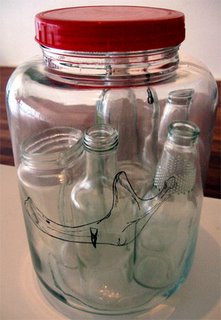

Sharon Chin, N.o. Substance : Disc 1 Disc 2, Acrylic on glass, 2005
[Numbers are the time for each song on New Order's double disc album Substance. Inside is the list of song titles]


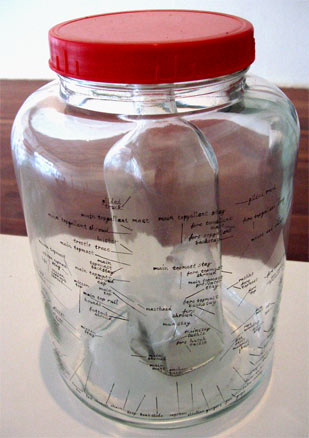
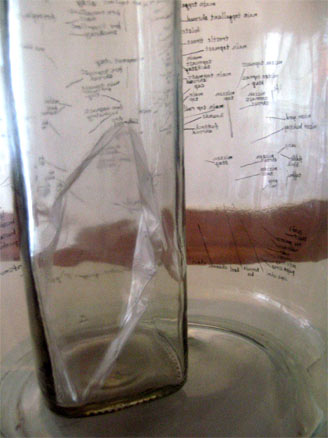
Sharon Chin, Dream, Acrylic on glass & acetate, 2005
[Text is the parts of a sailing ship, minus the ship. Inside the inner bottle is a boat folded from clear acetate]

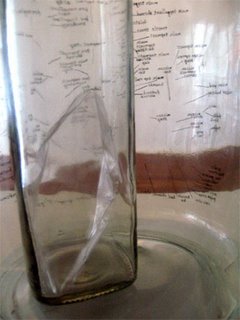
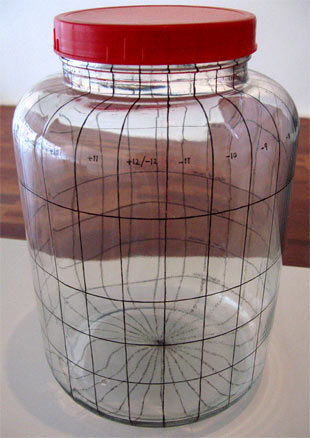
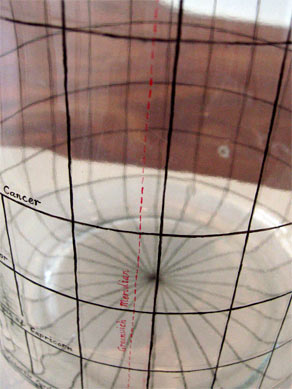
Sharon Chin, Lover, Acrylic on glass & windshield fragments, 2005
[Longtitude lines and lattitude lines. Two fragments from a broken windshield in their respective time zones]


These jars are the same ones that you find filled with sweets in coffeeshops and mamaks. You can get them at a dusty shop in Old PJ, alongside the most extensive collection of melamine-ware thine eyes will ever have the thrill of beholding.
In terms of collecting, sometimes the equipment is more fascinating than the collections themselves. Boxes, wooden framed cabinets with hinged lids of fine venetian glass, jars, labels, pins, nets, etc. They seem so futile! All about preserving, containing, classifying and displaying - they say a lot about the collector.
I don't really like to keep things, but when isolated in glass jars, transparent ideas take shape and form. They're very public because everyone can see inside, but they are still protected (trapped?) by fragile glass. This is pretty useful for observation purposes. Events can turn morbid though - leave the lids on too long and things die a slow death...
__________________________________________
Sharon Chin, City Scurvy, Acrylic on glass, 2005
[Couple of days ago, I recieved a phone call that informed me that whilst packing this work, the glass had slipped and cracked. This was in the early morning, and the call happened to retrieve me from a rather unpleasant nightmare I had been having. Weird.]
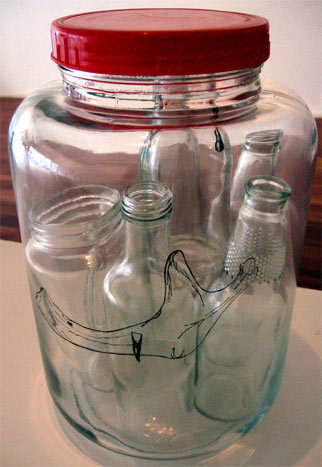
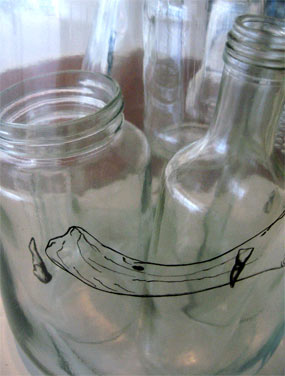
Sharon Chin, N.o. Substance : Disc 1 Disc 2, Acrylic on glass, 2005
[Numbers are the time for each song on New Order's double disc album Substance. Inside is the list of song titles]


Sharon Chin, Dream, Acrylic on glass & acetate, 2005
[Text is the parts of a sailing ship, minus the ship. Inside the inner bottle is a boat folded from clear acetate]
Sharon Chin, Lover, Acrylic on glass & windshield fragments, 2005
[Longtitude lines and lattitude lines. Two fragments from a broken windshield in their respective time zones]
Labels: art
¶ 1:03 PM 0 comments


